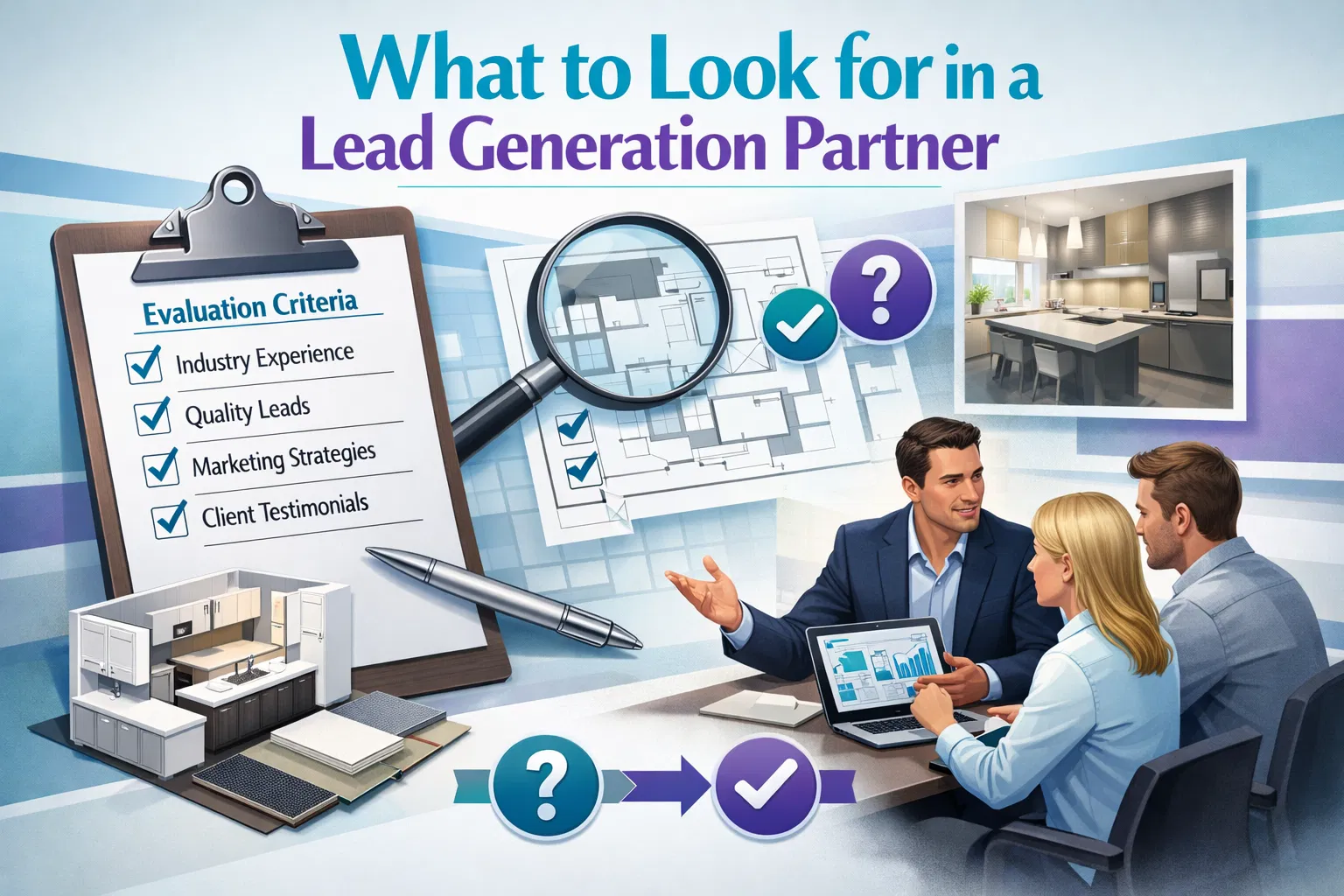
What to Look for in a Lead Generation Partner: A No-Nonsense Buyer's Guide
What to Look for in a Lead Generation Partner: A No-Nonsense Buyer's Guide
The Stakes
Choosing the wrong lead generation partner doesn't just waste money. It wastes your sales team's time, pollutes your pipeline with unqualified prospects, and — worst of all — costs you months you can't get back while a competitor is filling their calendar with the same budget you burned.
This decision deserves a clear framework.
The Seven Criteria That Actually Matter
1. They Specialize in Your Industry
A generalist agency that runs campaigns for dentists, law firms, and remodelers simultaneously does not have deep knowledge of your buyer's psychology, your sales cycle, or your market.
Industry specialization means the targeting, creative, and qualification criteria are calibrated from day one — not learned on your dime over the first three months.
What to ask: "What industries do you work with?" If the answer includes more than 2-3, they're not specialized.
2. They Own the Outcome, Not Just the Process
There is a fundamental difference between an agency that manages your marketing and an agency that is accountable for your results.
The former charges for effort. The latter charges for appointments.
Ask any prospective partner: What exactly are you promising?
If the answer involves impressions, reach, or ad spend efficiency, you are buying process. If the answer is a specific number of qualified appointments, you are buying an outcome.
What to ask: "What specific number of qualified appointments are you guaranteeing, and what happens if you miss?"
3. They Use AI, Not Just Automation
Basic automation — drip emails, scheduled follow-ups — is table stakes in 2025. The agencies producing consistently superior results are using machine learning for audience optimization, AI-assisted lead scoring, and dynamic creative testing.
The gap between AI-powered systems and manual ones compounds over time. Every month a system learns, it widens.
What to ask: "How are you using AI in your lead generation process?" Listen for specifics: audience optimization, lead scoring, creative testing.
4. They Have a Defined Qualification Process
Leads and appointments are not the same thing.
A lead is someone who filled out a form. An appointment is a qualified prospect with a specific project, a confirmed budget, and a scheduled meeting.
Any agency that conflates these two metrics is optimizing for volume, not quality.
What to ask: "What criteria does a lead have to meet before it hits my calendar?" If they can't answer precisely, keep looking.
5. You Control Your Ad Spend
Your media budget should go directly to the platforms — not through an agency account where they mark it up or bundle it into an opaque retainer.
You should have full visibility into what you're spending on ads and what it's producing.
An agency that insists on controlling your ad spend has a financial incentive that isn't perfectly aligned with yours.
What to ask: "Do I pay the ad platforms directly, or do you manage the budget?" If they manage it, ask why and what the markup is.
6. They Know Your Specific Market
A national agency with generic targeting does not understand the Dallas-Fort Worth homeowner. Buyer behavior, competitive density, seasonal patterns, and pricing expectations vary significantly by market.
Local market depth is not a nice-to-have — it directly affects targeting precision and conversion rates.
What to ask: "What do you know about my specific market?" Listen for specifics about local competition, seasonal trends, and buyer behavior.
7. The Risk Is on Them, Not You
If a partner is confident in their system, they will take on risk. If they aren't, they will ask you to.
Monthly retainers with no performance accountability are a signal: they're not confident enough in their own results to back them.
A guarantee is not a marketing tactic. It's a statement of operational certainty.
What to ask: "If you don't deliver the results you're promising, what exactly happens?"
The Question That Cuts Through Everything
"If you don't deliver the results you're promising, what exactly happens?"
The answer to that question tells you everything you need to know.
If the answer is:
- "We'll adjust the strategy" → They're not confident
- "We'll give you a discount" → They're negotiating, not guaranteeing
- "You get a refund on the shortfall" → They're confident enough to back it
Red Flags to Watch For
- Vague metrics — If they talk about impressions, reach, or clicks instead of appointments, move on
- No specialization — If they work with 10+ industries, they're not specialized
- No transparency — If you can't see your ad spend and results in real time, something's wrong
- No risk reversal — If all the risk is on you, the incentives aren't aligned
- No defined qualification process — If they can't explain how they qualify leads, they're not qualifying them
The Decision Framework
Before you sign with any lead generation partner, they should be able to answer these questions clearly:
- What industries do you specialize in?
- What specific number of qualified appointments are you guaranteeing?
- How are you using AI in your process?
- What's your lead qualification criteria?
- Do I control my ad spend?
- What do you know about my market?
- If you miss your guarantee, what happens?
If they can't answer all seven clearly and confidently, they're not ready for your business.
The Bottom Line
Evaluating a lead generation partner is about alignment. You want a partner who:
- Specializes in your industry
- Owns the outcome
- Uses modern technology
- Has a defined process
- Gives you visibility and control
- Understands your market
- Takes on risk
When you find that partner, the decision is easy.